BOOK NOTES · A NEW EARTH
زمینی نو
01/14
BOOK SUMMARY · KEY IDEAS OF EACH CHAPTER
A New Earth
10 chapters, one card each + key takeaways۱۰ فصل، هر فصل یک کارت + نکتههای کلیدی

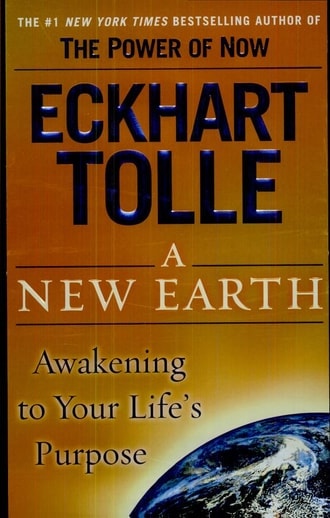
Cover image: Google Books
BOOK SUMMARY · KEY IDEAS OF EACH CHAPTER
Read in فارسی
Identifying with the ego is the inherited dysfunction, and a shift in consciousness can begin now.
These are Tolle's spiritual teachings, offered as perspectives, not as guarantees or professional advice.
A New Earth: Awakening to Your Life's Purpose (2005) opens with the first flower as a sign of a leap in evolution, and Tolle suggests humanity may be near a similar leap if it stops identifying with the thinking mind. He describes the ego, role-playing and the pain-body, then inner space and an inner purpose he states simply: to awaken.…
A New Earth was written by Eckhart Tolle.
Key lessons include: Notice the voice in the head; you are the one aware of it.; Watch complaining, reactivity and the need to be right.; Hold roles lightly; do the function without the identity.
This summary is for readers who want identifying with the ego is the inherited dysfunction, and a shift in consciousness can begin now.
A New Earth: Awakening to Your Life's Purpose (2005) opens with the first flower as a sign of a leap in evolution, and Tolle suggests humanity may be near a similar leap if it stops identifying with the thinking mind. He describes the ego, role-playing and the pain-body, then inner space and an inner purpose he states simply: to awaken. A new earth, in his view, is not a future utopia but a change in consciousness that can begin now, through acceptance, enjoyment or enthusiasm.
Tolle opens with an image: the first flower on Earth, about 114 million years ago, as a sign of a sudden leap in evolution. He suggests humanity may be near a similar leap. Our inherited dysfunction, he says, is identifying with the thinking mind, and it shows in violence and destruction. He separates spirituality from religion: what matters is a change in consciousness, not a belief system, and he sees that change as urgent.
In Tolle's teaching, the ego is a false sense of self built from thoughts and identifications. He calls it the voice in the head. Its content changes, from possessions and status to the body, but its structure stays the same: it identifies with things and always wants more. He offers feeling the inner body as a way to step out of thought, and treats Descartes' 'I think, therefore I am' as a mistake that equates being with thinking.
Tolle describes the ego's core habits: complaining, resentment, reactivity and holding grievances. It needs to be right and make others wrong, and it builds its identity through opposition, which on a larger scale he links to war as a mind-set. He asks whether you want peace or drama. The ego also seeks to feel superior, for example through fame. He says seeing the ego is not personal, and that all forms are unstable, helps loosen its hold.
The ego plays roles such as villain, victim or lover, and identifies with social roles like teacher, parent or expert. Tolle suggests doing what a function requires without turning it into an identity. He describes conscious parenting, where you are present with your child instead of only playing the parent. He links a background unhappiness to the ego, says unhappiness often comes from our thoughts about a situation, and also looks at the ego at work, in illness and in groups.
Tolle uses the term pain-body for an accumulation of old emotional pain that lives on in people and in groups. He contrasts it with a duck that shakes off a fight and moves on, while the human mind keeps replaying the past. The pain-body is mostly dormant, then wakes up and feeds on negative thoughts and on drama with others. He also describes collective forms, such as national, racial and a collective female pain-body.
For Tolle, the way out of the pain-body is presence: noticing it as it arises instead of being taken over by it. He describes how it shows up in children and in moods of unhappiness, and how certain triggers activate it. When you watch it without identifying with it, he says, it can no longer feed on your thoughts, and the pain-body can even become a doorway to awakening.
Tolle separates knowing about yourself, your story and self-image, from knowing yourself as the awareness behind it. He suggests not minding what happens, illustrated by a Zen master who answers praise and blame alike with 'Is that so?'. He calls the present moment the only point where life exists, while the ego lives in past and future. Allowing the ego to diminish, for instance by not defending yourself, is presented as a path to the joy of Being.
Tolle contrasts object consciousness, awareness of things and thoughts, with space consciousness, the still awareness in which they appear. He suggests ways to sense this inner space: perceiving without naming, listening to sounds such as a mountain stream, following the breath, feeling the inner body and noticing the gaps between thoughts. He also discusses addictions and television as ways of falling below thought rather than rising above it.
Tolle separates two purposes. The inner purpose is shared by everyone; in his words, 'Your inner purpose is to awaken. It is as simple as that.' The outer purpose, what you do, differs from person to person and can change over time. He argues that living in line with the inner purpose comes first and gives the outer one its meaning. Much of the chapter is a question-and-answer dialogue on how this applies to everyday life.
Tolle describes life as an outgoing movement of growth and a return movement of letting go, both of which can serve awakening. He proposes awakened doing in three modalities: acceptance, enjoyment and enthusiasm, depending on the task. He calls people who bring presence to ordinary life frequency-holders. For him, a new earth is no utopia in the future, but a change in consciousness that can begin in the present moment.
The same summary, as swipeable cards.
BOOK NOTES · A NEW EARTHA New Earth: Awakening to Your Life's Purpose (2005) opens with the first flower as a sign of a leap in evolution, and Tolle suggests humanity may be near a similar leap if it stops identifying with the thinking mind. He describes the ego, role-playing and the pain-body, then inner space and an inner purpose he states simply: to awaken. A new earth, in his view, is not a future utopia but a change in consciousness that can begin now, through acceptance, enjoyment or enthusiasm.