1Breaking All the Rules
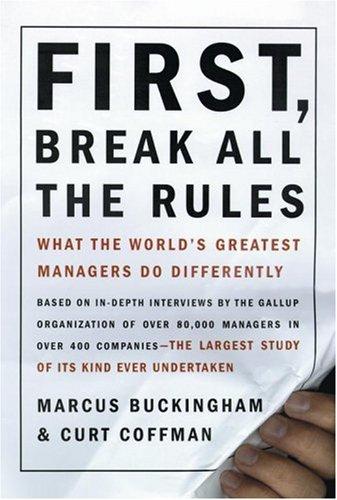
The book draws on two large Gallup research efforts: surveys of employees about their workplaces and in-depth interviews with more than 80,000 managers in over 400 companies. The authors' finding is that the best managers share little in style, yet they agree on one thing: they reject much of the conventional wisdom about managing people. In their view, the front-line manager, not pay or perks, is the key to attracting and keeping talented employees.
2The Measuring Stick
The chapter opens with a historic shipwreck caused by sailors who could not measure longitude, a metaphor for what happens when we cannot measure what matters. Gallup set out to measure the strength of a workplace and narrowed thousands of survey questions down to twelve. The authors report that teams scoring higher on these questions tended to do better on productivity, profit, retention and customer satisfaction, and that the immediate manager shapes the answers most.
3Climbing the Mountain
In short form, the twelve ask whether people: know what is expected; have the tools to do the work right; do what they do best every day; were recently recognized; have someone who cares about them; and someone who encourages their growth; feel their opinions count; see their job as important to the mission; have colleagues committed to quality; have a best friend at work; have talked about their progress lately; and have had chances to learn and grow. The authors arrange them as a climb, from basic needs to growth.
4The Wisdom of Great Managers
The central insight the authors draw from their interviews is that people do not change much, so a manager's job is to draw out what is already there rather than put in what is missing. They describe four basic roles of a manager: selecting a person, setting expectations, motivating, and developing. Great managers play each role in a way that breaks a conventional rule, which the authors call the Four Keys.
5The First Key: Select for Talent
The authors define talent broadly, as a recurring pattern of thought, feeling or behaviour that can be put to productive use. They separate skills and knowledge, which can be taught, from talents, which they see as largely set by adulthood. Every role done excellently needs talent, so great managers hire for talent rather than for experience, brainpower or willpower alone, and they know which talents a specific role requires.
6The Second Key: Define the Right Outcomes
Managers are tempted to control people by spelling out every step. Great managers, the authors argue, define the outcomes they want and let each person find their own route there. Steps still matter in a few cases, such as accuracy, safety, or standards that are core to the company or industry. The outcomes themselves should be right: aligned with what customers value and with the goals of the organization.
7The Third Key: Focus on Strengths
Instead of trying to fix each person's weaknesses, great managers help people become more of who they already are. They cast people in roles that use their talents, treat each person as an individual rather than applying one rule to everyone, and spend the most time with their best people. When a weakness gets in the way, they manage around it, for example with a support system, a complementary partner, or a different way of doing the work.
8The Fourth Key: Find the Right Fit
The traditional career path pushes people up a ladder, often into roles that do not suit their talents. The authors suggest that excellence in one role does not guarantee excellence in the next, and recommend creating heroes in every role, with levels of achievement and pay that let people grow without leaving work they do well. When someone is in the wrong role, great managers practise tough love: they act on poor performance while keeping respect and the relationship intact.
9Turning the Keys: A Practical Guide
The last chapter turns the keys into practice. For hiring, the authors suggest open-ended interview questions and listening for specific, spontaneous answers that reveal talent. For performance management, they describe a simple routine of regular one-on-one conversations focused on outcomes, strengths and fit. Employees can turn the keys for themselves too, and companies can support great managers by measuring and rewarding what matters.

 BOOK NOTES · FIRST, BREAK ALL THE RULES