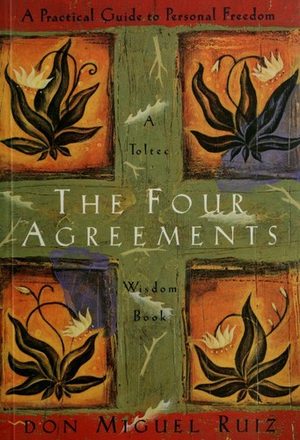
Cover image: Open Library
BOOK SUMMARY · MAIN IDEA OF EACH CHAPTER
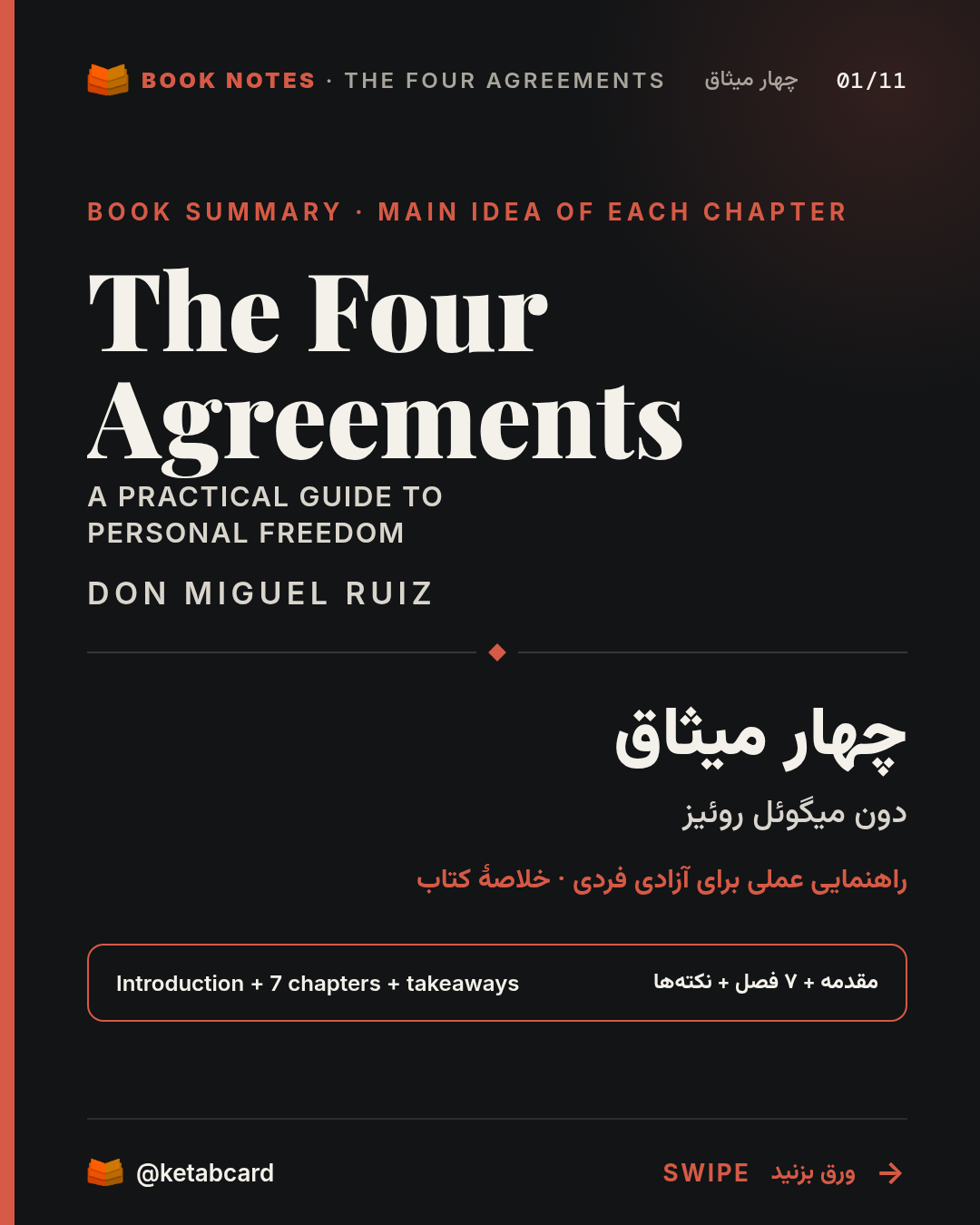
The Four Agreements
A PRACTICAL GUIDE TO PERSONAL FREEDOM
Toltec wisdom for seeing through the smoke of our beliefs and words.
- 3 min read
- 8 chapters
- 6 key lessons
The book in brief
Ruiz opens with a Toltec story: everything, ourselves included, is made of light, and every person is a mirror reflecting that light. Smoke between the mirrors — the dream of our beliefs and words — keeps us from seeing it. The book draws on this Toltec wisdom to help us see through that smoke.
Key lessons
- Be impeccable with your word.
- Don't take anything personally.
- Don't make assumptions.
- Always do your best.
- Notice the fear-based agreements you live by.
- Break them one by one, and forgive yourself along the way.
Chapter by chapter
1Domestication and the Dream of the Planet
The mind dreams all the time, and society has a shared dream: its rules, beliefs and ways to be. As children, we are domesticated through punishment and reward until we agree with that dream and stop being ourselves. These agreements form a Book of Law in our minds, enforced by an inner Judge and suffered by an inner Victim. The result is a life ruled by fear, which the four agreements aim to change.
2Be Impeccable with Your Word
Your word is your most powerful tool: it can create a beautiful life or destroy one. Ruiz reads impeccable as not acting against yourself. Words used against yourself or others, from self-criticism to gossip, spread like poison and plant harmful beliefs; a single careless remark can shape someone for years. Speak with integrity, say only what you mean, and use your word in the direction of truth and love.
3Don't Take Anything Personally
Nothing others do is really because of you. What people say and do is a projection of their own reality, their own dream. Taking things personally comes from personal importance, the belief that everything is about us, and it makes us easy targets for other people's emotional poison. Once you stop, praise and insults lose their grip, you need far less approval, and you avoid much needless suffering.
4Don't Make Assumptions
We tend to assume we know what others think and want, then believe our assumptions as if they were true. Then we take them personally, blame others, and create drama out of nothing. In relationships we expect people to read our minds. The cure is courage: ask questions until you understand, and say clearly what you really want. Clear communication removes much of the misunderstanding that hurts us.
5Always Do Your Best
Your best changes from moment to moment: it differs when you are rested or tired, healthy or sick. Do no more and no less than your best. Overdoing it drains you, while doing less invites guilt, regret and self-judgment. Doing your best means taking action because you enjoy it, not only for a reward. This agreement holds the other three together: when you fall short, you simply begin again.
6The Toltec Path to Freedom
Freedom means being who we really are, as we were as children before domestication. Ruiz describes three Toltec masteries on the path: the Mastery of Awareness, seeing our beliefs as they are; the Mastery of Transformation, changing them; and the Mastery of Intent, or love. He calls the inner Judge and Victim, with the belief system behind them, a parasite that feeds on fear and keeps us from being free.
7Breaking Old Agreements
Every fear-based agreement uses up energy, so each one you break gives energy back. Start small, and replace old agreements with the four new ones. Forgiveness heals the emotional wounds that hold old agreements in place: forgive those who hurt you, and forgive yourself. Ruiz also describes the Toltec practice of facing death, living each day as if it might be the last, so we stop waiting to live fully.
8The New Dream: Heaven on Earth
Ruiz asks us to imagine a life without fear: free of judgment, needless guilt and the need for approval, where we love ourselves and others without conditions. That life, he says, is a new dream we can create here and now. Heaven and hell are states of mind, not places. Self-acceptance is the starting point, and the four agreements are the practical tools for dreaming that new dream.
The Instagram cards
The same summary, as swipeable cards.
BOOK NOTES · THE FOUR AGREEMENTS
چهار میثاق
02/12
INTRODUCTION
The Smoky Mirror
Ruiz opens with a Toltec story: everything, ourselves included, is made of light, and every person is a mirror reflecting that light. Smoke between the mirrors — the dream of our beliefs and words — keeps us from seeing it. The book draws on this Toltec wisdom to help us see through that smoke.
BOOK NOTES · THE FOUR AGREEMENTS
چهار میثاق
03/12
KEY TAKEAWAYS
Key takeaways
- Be impeccable with your word.
- Don't take anything personally.
- Don't make assumptions.
- Always do your best.
- Notice the fear-based agreements you live by.
- Break them one by one, and forgive yourself along the way.
BOOK NOTES · THE FOUR AGREEMENTS
چهار میثاق
04/12
CHAPTER 1
Domestication and the Dream of the Planet
The mind dreams all the time, and society has a shared dream: its rules, beliefs and ways to be. As children, we are domesticated through punishment and reward until we agree with that dream and stop being ourselves. These agreements form a Book of Law in our minds, enforced by an inner Judge and suffered by an inner Victim. The result is a life ruled by fear, which the four agreements aim to change.
BOOK NOTES · THE FOUR AGREEMENTS
چهار میثاق
05/12
CHAPTER 2 · THE FIRST AGREEMENT
Be Impeccable with Your Word
Your word is your most powerful tool: it can create a beautiful life or destroy one. Ruiz reads impeccable as not acting against yourself. Words used against yourself or others, from self-criticism to gossip, spread like poison and plant harmful beliefs; a single careless remark can shape someone for years. Speak with integrity, say only what you mean, and use your word in the direction of truth and love.
BOOK NOTES · THE FOUR AGREEMENTS
چهار میثاق
06/12
CHAPTER 3 · THE SECOND AGREEMENT
Don't Take Anything Personally
Nothing others do is really because of you. What people say and do is a projection of their own reality, their own dream. Taking things personally comes from personal importance, the belief that everything is about us, and it makes us easy targets for other people's emotional poison. Once you stop, praise and insults lose their grip, you need far less approval, and you avoid much needless suffering.
BOOK NOTES · THE FOUR AGREEMENTS
چهار میثاق
07/12
CHAPTER 4 · THE THIRD AGREEMENT
Don't Make Assumptions
We tend to assume we know what others think and want, then believe our assumptions as if they were true. Then we take them personally, blame others, and create drama out of nothing. In relationships we expect people to read our minds. The cure is courage: ask questions until you understand, and say clearly what you really want. Clear communication removes much of the misunderstanding that hurts us.
BOOK NOTES · THE FOUR AGREEMENTS
چهار میثاق
08/12
CHAPTER 5 · THE FOURTH AGREEMENT
Always Do Your Best
Your best changes from moment to moment: it differs when you are rested or tired, healthy or sick. Do no more and no less than your best. Overdoing it drains you, while doing less invites guilt, regret and self-judgment. Doing your best means taking action because you enjoy it, not only for a reward. This agreement holds the other three together: when you fall short, you simply begin again.
BOOK NOTES · THE FOUR AGREEMENTS
چهار میثاق
09/12
CHAPTER 6 · PART 1
The Toltec Path to Freedom
Freedom means being who we really are, as we were as children before domestication. Ruiz describes three Toltec masteries on the path: the Mastery of Awareness, seeing our beliefs as they are; the Mastery of Transformation, changing them; and the Mastery of Intent, or love. He calls the inner Judge and Victim, with the belief system behind them, a parasite that feeds on fear and keeps us from being free.
BOOK NOTES · THE FOUR AGREEMENTS
چهار میثاق
10/12
CHAPTER 6 · PART 2
Breaking Old Agreements
Every fear-based agreement uses up energy, so each one you break gives energy back. Start small, and replace old agreements with the four new ones. Forgiveness heals the emotional wounds that hold old agreements in place: forgive those who hurt you, and forgive yourself. Ruiz also describes the Toltec practice of facing death, living each day as if it might be the last, so we stop waiting to live fully.
BOOK NOTES · THE FOUR AGREEMENTS
چهار میثاق
11/12
CHAPTER 7
The New Dream: Heaven on Earth
Ruiz asks us to imagine a life without fear: free of judgment, needless guilt and the need for approval, where we love ourselves and others without conditions. That life, he says, is a new dream we can create here and now. Heaven and hell are states of mind, not places. Self-acceptance is the starting point, and the four agreements are the practical tools for dreaming that new dream.
BOOK NOTES · THE FOUR AGREEMENTS
چهار میثاق
12/12
FREE PDF
Download the free summary deck (PDF)
Enter your email and confirm that we may store it with the language of this page and the name of this book. We use that to give you the deck and to know which summary you asked for.