 BOOK NOTES · LOOK AGAIN
دوباره نگاه کن
01/13
BOOK SUMMARY · CHAPTER BY CHAPTER
Look Again
14 chapters in 10 cards + key takeaways۱۴ فصل، در ۱۰ کارت + نکتههای کلیدی

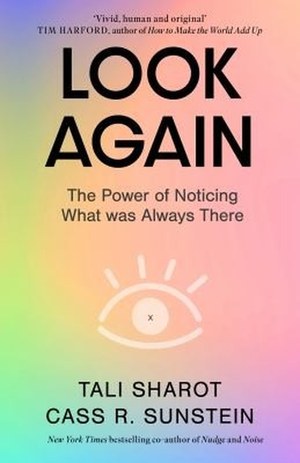
Cover image: Simon & Schuster
Read in فارسی
We stop noticing what stays the same, the good and the bad. A change of scene lets you see it again.
Chapter titles follow the Atria / One Signal 2024 edition. No direct quotes; everything is paraphrased.
We stop noticing what stays the same.
Take breaks to make good things sparkle again.
Chop up the good; swallow the bad whole.
Step away from habits to see whether they serve you.
Be wary of claims that feel true only because they are familiar.
Look again at what everyone accepts.
Tali Sharot and Cass R. Sunstein's Look Again: The Power of Noticing What Was Always There (Atria / One Signal, 2024) argues that we stop noticing what stays the same, the good and the bad. A change of scene lets you see it again. The authors call the brain's fading response to what stays the same habituation, and the way back dishabituation.
Enter your email and confirm that we may store it with the language of this page and the name of this book. We use that to give you the deck and to know which summary you asked for.
The brain responds strongly to what is new and less and less to what stays the same. Scientists call this habituation. It is why a new home, job or relationship thrills us at first and then fades into the background. Sharot and Sunstein argue that the way back is dishabituation: stepping away for a while so that the good things in your life can sparkle again when you return.
Breaks change how experiences feel. Interrupting something pleasant makes it more enjoyable when you return to it, while interrupting something unpleasant makes it worse. So the authors' advice is to chop up the good and swallow the bad whole: spread out treats, and get chores done in one go. They also describe research in which people facing a big decision let a coin flip decide; those who made a change tended to be happier months later.
Constant scrolling keeps us in a state where we cannot notice how it makes us feel. In one large experiment, people paid to deactivate Facebook for a few weeks reported being somewhat happier and less anxious, and many used it less afterward. A break lets you see your habits from the outside. Only then can you judge whether they are worth keeping.
Habituation also protects us: we get used to hardship, which helps us cope with loss and pain. But it also makes us accept bad situations we could change. In creativity, habituation is a trap. When everyone does something the same way, no one sees another way. The authors tell the story of Dick Fosbury, who went over the high-jump bar backward and won Olympic gold in 1968, changing the sport. Fresh eyes notice what experts stop seeing.
Small dishonesty can grow because the brain habituates to it. Research shows that emotional responses fade with each repeated self-serving lie, so the next lie feels easier. Repetition shapes belief too: hearing a claim again and again makes it feel truer, even when it is false. This is called the illusory truth effect. Knowing it, you can pause before trusting what merely feels familiar.
We get used to dangers we live with every day, and stop taking care. When Sweden switched from driving on the left to driving on the right in September 1967, accidents fell for a time because drivers, faced with something unfamiliar, paid close attention. The same blindness affects our surroundings: people stop noticing pollution, noise or smells they live with. Making the familiar strange again can make us safer and healthier.
Habituation hides unfairness. People who live with discrimination every day, or who benefit from it, can stop seeing it as anything unusual. Progress often begins when someone looks again, notices that what everyone accepts is wrong, and says so. The authors give examples of how one person pointing out something everyone had walked past, such as a biased public poster, can make others suddenly see it.
Freedoms rarely disappear in one dramatic step. The authors draw on accounts of ordinary Germans in the 1930s, who adjusted to each small change until the unthinkable seemed normal. Each step looked minor compared with the last. In law, habituation matters too: people often adapt to some losses more than they expect and to others less, which raises hard questions about how harm should be judged and compensated.
The authors close with an invitation drawn from the philosopher John Stuart Mill: try experiments in living. New places, people and ways of doing things wake us up to what we had stopped seeing, both in the world and in our own lives. Travel, a new routine or a short break from something you love can all act as a reset. Then you can decide, with clear eyes, what to keep and what to change.
Look Again was written by Tali Sharot & Cass R. Sunstein.
Key lessons include: We stop noticing what stays the same.; Take breaks to make good things sparkle again.; Chop up the good; swallow the bad whole.
This summary is for readers who want we stop noticing what stays the same, the good and the bad. A change of scene lets you see it again.
The same summary, as swipeable cards.
BOOK NOTES · LOOK AGAINTali Sharot and Cass R. Sunstein's Look Again: The Power of Noticing What Was Always There (Atria / One Signal, 2024) argues that we stop noticing what stays the same, the good and the bad. A change of scene lets you see it again. The authors call the brain's fading response to what stays the same habituation, and the way back dishabituation.