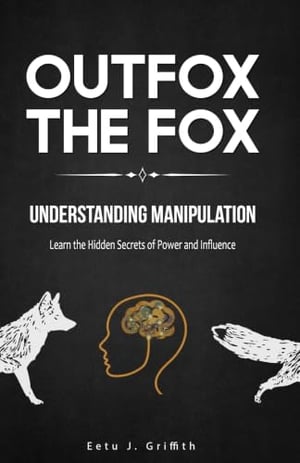

Cover image: Amazon
Outfox the Fox Book Summary
Read in فارسی
How manipulators work, from Ponzi to Cleopatra, and how to protect yourself.
- 3 min read
- 7 chapters
- 11 slides
Chapter titles follow the published Persian edition's contents, rendered in English by us. Read the full book for the historical stories in detail.
Key takeaways
Manipulators rarely look like villains; they hide what they want.
Greed and urgency are the classic levers. Slow down.
The less you know, the easier you are to fool. Learn first.
At scale, manipulation serves the few at the cost of the many.
Judge people by what they do, not by their image or charm.
Check claims independently, set boundaries, and ask who gains.
What is this summary about?
Eetu J. Griffith's Outfox the Fox: Understanding Manipulation: Learn the Hidden Secrets of Power and Influence (2019) looks at how manipulators work and how to protect yourself. Through four historical cases, the Ponzi scheme, Napoleon, Machiavelli's The Prince and Cleopatra, Griffith shows how manipulators exploit greed, urgency, ignorance, image and charm, and then lays out simple defenses: slow down, verify independently, set boundaries and ask who gains.
Download the free summary deck (PDF)
Enter your email and confirm that we may store it with the language of this page and the name of this book. We use that to give you the deck and to know which summary you asked for.
Chapter by chapter
1Manipulation in the Modern World
Griffith starts from a simple point: we are social creatures, and everyone influences others in some way. His concern is the harmful kind, people who exploit human nature for their own ends and hide what they are doing. Thinking that everyone always means well can leave you exposed. In a world where anyone can spread information widely, he suggests asking who gains when you accept an offer or an idea.
2The Ponzi Scheme: Manipulation Through Greed
The first case is the Ponzi scheme, named after Charles Ponzi, as a systematic model of deception that works by stirring greed with the promise of high returns. Griffith points to two levers. Manipulators push for quick decisions and create a sense of urgency, because under pressure we decide poorly and without enough information. And the less we know about a subject, the easier it is to fool us about it.
3The Napoleon Complex: Mass Manipulation for Power
The second case moves from individuals to whole populations. Using Napoleon's rise in the era of the French Revolution, Griffith looks at how a leader can shape public opinion and quiet dissent to gain and hold power. His wider point is that manipulation at this scale usually serves a few, or one person, at the cost of many, and that people with power are better placed to use it against those with less information.
4Machiavellian Manipulation: Lessons from The Prince
The third chapter draws on Machiavelli's The Prince, the classic text on gaining and keeping power, where how a ruler appears can matter as much as what he does. Griffith uses Machiavelli's observation that a deceiver will always find people willing to be deceived. For the reader, the lesson is defensive: understand how power-seekers manage their image, so you judge people by what they do rather than how they present themselves.
5Cleopatra: Persuasive and Seductive Manipulation
Women who came to power after the death of a husband, father or brother were not rare in the ancient world, Griffith notes, but few left a lasting mark or ruled for long. Cleopatra was different. He uses her story to show persuasion and charm as tools of influence, and how attraction and attention can move people. The takeaway: warmth and charm are not proof of good intent.
6Fighting Manipulation
The last chapter turns to defense, and it is the book's only chapter devoted to practical advice. The core moves: notice when emotion is being stirred and keep it from deciding for you; refuse artificial urgency and take time before committing; check claims through independent sources; set clear boundaries and say no; and if a relationship keeps exploiting you, step away from it. A calm mind makes better decisions.
7Final Word
Griffith admits that a reader may come away with a certain respect for the cunning behind large-scale manipulation. He presents the book as a neutral guide that describes manipulation, shows how it gains power and how it can be stopped. What you do with that knowledge is up to you; his hope is that it is used for good, and above all to keep yourself and the people around you from being used.
What do readers ask about Outfox the Fox?
Who is the author of Outfox the Fox?
Outfox the Fox was written by Eetu J. Griffith.
What are the main lessons in Outfox the Fox?
Key lessons include: Manipulators rarely look like villains; they hide what they want.; Greed and urgency are the classic levers. Slow down.; The less you know, the easier you are to fool. Learn first.
Who should read Outfox the Fox?
This summary is for readers who want how manipulators work, from Ponzi to Cleopatra, and how to protect yourself.
What do the Instagram cards look like?
The same summary, as swipeable cards.
The book in brief
Eetu J. Griffith's Outfox the Fox: Understanding Manipulation: Learn the Hidden Secrets of Power and Influence (2019) looks at how manipulators work and how to protect yourself. Through four historical cases, the Ponzi scheme, Napoleon, Machiavelli's The Prince and Cleopatra, Griffith shows how manipulators exploit greed, urgency, ignorance, image and charm, and then lays out simple defenses: slow down, verify independently, set boundaries and ask who gains.