 BOOK NOTES · SUPERFORECASTING
هنر پیشبینی
01/18
BOOK SUMMARY · CHAPTER BY CHAPTER
Superforecasting
12 chapters, epilogue and appendix, in 14 cards + key takeaways۱۲ فصل، پایانسخن و پیوست، در ۱۴ کارت + نکتههای کلیدی

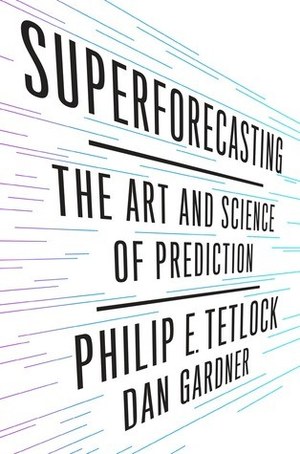
Cover image: Open Library
Read in فارسی
Think in numbers, update often, keep score, and get better at seeing what comes next.
Chapter titles follow the Crown 2015 edition. The one quote (ch. 5) is the authors'; everything else is paraphrased.
Put a number on it: say 70%, not “probably.”
Start with how often this usually happens, then add the details.
Break big questions into small ones you can answer.
Update often, in small steps, as evidence arrives.
Keep score: clear feedback turns guessing into skill.
Treat your beliefs as hypotheses to test.
Philip E. Tetlock and Dan Gardner's Superforecasting: The Art and Science of Prediction (Crown, 2015) argues that foresight is a skill that can be measured and improved. In a four-year US government forecasting tournament, the volunteers of the Good Judgment Project beat a control group by 60% and then 78%, and even beat intelligence analysts with classified data. The book asks readers to think in numbers, update often, and keep score.
Enter your email and confirm that we may store it with the language of this page and the name of this book. We use that to give you the deck and to know which summary you asked for.
We are all forecasters, yet expert predictions are rarely checked. In Tetlock's long study of experts, the average expert was roughly as accurate as a dart-throwing chimpanzee. Some limits are real: a tiny cause, like one Tunisian fruit seller's protest, can change history. Still, Tetlock is an optimistic skeptic. Foresight is a skill that can be measured and improved. In a four-year US government forecasting tournament, the volunteers of his Good Judgment Project beat a control group by 60% and then 78%, and even beat intelligence analysts with classified data.
In 1956 a surgeon told Archie Cochrane that his cancer had spread; the lab later found no cancer at all. The confident verdict was never tested. Cochrane went on to champion randomized trials, which made medicine scientific. Our minds share the surgeon's weakness. Fast, intuitive thinking builds a story from whatever is in view and feels certain; slow, careful thinking rarely checks it. We quietly swap a hard question for an easier one. Tetlock calls this the tip-of-your-nose perspective: often useful, but it must be tested, not trusted.
To judge forecasts, they must be clear. In 1951 the CIA's Sherman Kent asked his team what “serious possibility” meant in their own report; the answers ranged from 80% likely to 20%. Good forecasts need numbers, deadlines and many repeats, because one hit proves little. The Brier score measures the gap between forecast and outcome: 0 is perfect, 0.5 is random guessing, 2.0 is confidently wrong every time. In Tetlock's earlier study, “foxes” who drew on many ideas beat “hedgehogs” organised around one big idea.
Each year the project picked its top 2% and called them superforecasters. Doug Lorch, a retired IBM programmer, made about 1,000 forecasts in his first year and finished fifth of 2,800 volunteers; the next year, on a team of supers, he scored best of all. Was it luck? Some players did slip back, as luck predicts, but about 70% of supers kept their place each year. The 2002 Iraq weapons estimate shows a related lesson: a reasonable judgment can still be wrong, and its real flaw was too much certainty.
The one direct quote in this deck (Tetlock & Gardner, ch. 5). Superforecasters scored higher than about 80% of the population on intelligence tests, but they are not geniuses; how they think matters more. They break a hard question into smaller ones they can estimate. They start with the outside view: how often does this kind of thing happen? Then they adjust with the details of the case. They gather many perspectives and stay actively open-minded. In the authors' words: “For superforecasters, beliefs are hypotheses to be tested, not treasures to be guarded.”
Supers are good with numbers but rarely use fancy maths; what they share is probabilistic thinking. Before the bin Laden raid, CIA officers' estimates ranged widely, with a median around 70%, and President Obama called it “fifty-fifty.” The authors suggest he likely meant simply “maybe.” Many people think with three settings: yes, no, maybe. Supers make finer distinctions, and they lost accuracy when their forecasts were rounded even to the nearest 5%. They also resist thinking that events were “meant to be” and see that things could have gone otherwise.
Supers are not glued to the news, but they keep updating. Tim Minto, a Vancouver software engineer who took top spot in the tournament's third season, made 77 forecasts on a single question, moving a few points at a time as new information came in. Updating has two traps. We underreact when we are attached to a belief, and we overreact when we chase every headline or irrelevant detail. The best forecasters update often and in small steps, in the spirit of Bayes' theorem: let each piece of evidence move you as much as it deserves.
Mary Simpson, an economist, missed the 2008 crisis and saw her retirement savings fall. She joined the project to get better, and became a superforecaster. The key is a growth mindset: believe you can improve, then practise with clear feedback. The cycle is try, fail, analyse, adjust, and try again. Vague forecasts and hindsight bias rob us of that feedback. Of all the traits studied, “perpetual beta,” a commitment to updating beliefs and improving yourself, was the strongest predictor of becoming a superforecaster, about three times as powerful as intelligence.
Groups can fall into groupthink, as Kennedy's team did before the Bay of Pigs; yet the same team handled the Cuban missile crisis far better after changing how it debated. In the tournament, forecasters on teams were on average 23% more accurate than those working alone. When the best forecasters were grouped together, superteams beat prediction markets by 15 to 30 percent. What made them work was not just talent: respectful challenge, sharing information, precise questions, and a culture of giving more than taking.
Leaders must be confident and decisive; superforecasting asks for humility and doubt. Can one person do both? Tetlock points to the Prussian general Helmuth von Moltke, who taught that in war everything is uncertain. His army's “mission command” told officers the goal and why it mattered, but left them free to decide how. Leaders can be decisive about action while staying open about their assumptions. The authors note that this army later served the Nazi regime; learning from it is not endorsing it. The humility needed is intellectual, not a lack of self-confidence.
Tetlock takes two big critics seriously. Daniel Kahneman doubted that anyone could escape the biases he documented. In one test, regular forecasters gave the fall of Syria's Assad regime about the same odds over three months (40%) as over six (41%); superforecasters gave 15% and 24%, a sensible difference. Nassim Taleb argues that history is driven by black swans no one can foresee. The authors reply that many such events were imaginable in advance, but agree that accuracy fades the further ahead you look, so long-range forecasts call for humility.
Superforecasters called Scotland's 2014 independence vote correctly, yet pundits mostly explained the result after the fact. Forecasting often serves other goals: entertaining, advancing an agenda, or protecting reputations. Lenin's question “who, whom?” is about power, not accuracy. Tetlock still hopes for change, as evidence once changed medicine. Big questions can be broken into smaller, testable ones, pairing “superquestioners” who ask the right questions with superforecasters who answer them. Rival camps could even test their predictions against each other. The first step is to get serious about keeping score.
The book ends where it began, with Bill Flack, a retired US Department of Agriculture employee in Kearney, Nebraska, and one of the volunteers who outperformed the experts. He is precise about probabilities, humble about what he knows, and treats pundits' views like a lawyer's arguments: evidence to weigh, not answers to accept. As the authors put it, Bill Flack is perpetual beta. The closing invitation is literal: readers can test their own forecasting skill and join the research through Good Judgment.
(1) Triage: spend effort where it pays off. (2) Break hard problems into smaller ones. (3) Balance the outside view and the inside view. (4) Update, neither too little nor too much. (5) Look for the clashing forces at work. (6) Use as many degrees of doubt as the problem allows. (7) Balance confidence and caution. (8) Study your errors, but beware hindsight bias. (9) Bring out the best in others. (10) Practise: learn to ride the error-balancing bicycle. (11) Don't treat these commandments as commandments.
Superforecasting was written by Philip E. Tetlock & Dan Gardner.
Key lessons include: Put a number on it: say 70%, not “probably.”; Start with how often this usually happens, then add the details.; Break big questions into small ones you can answer.
This summary is for readers who want think in numbers, update often, keep score, and get better at seeing what comes next.
The same summary, as swipeable cards.
BOOK NOTES · SUPERFORECASTINGPhilip E. Tetlock and Dan Gardner's Superforecasting: The Art and Science of Prediction (Crown, 2015) argues that foresight is a skill that can be measured and improved. In a four-year US government forecasting tournament, the volunteers of the Good Judgment Project beat a control group by 60% and then 78%, and even beat intelligence analysts with classified data. The book asks readers to think in numbers, update often, and keep score.