1On the Plumage of Birds
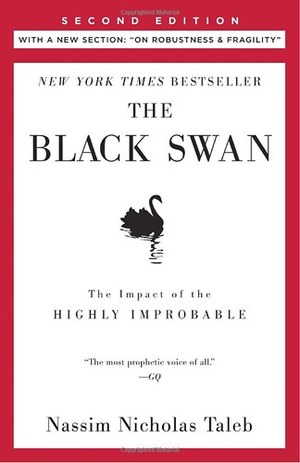
The one quote from the prologue (Taleb, 2007/2010). Before Australia, people in the Old World were sure all swans were white; one sighting of a black swan undid that certainty. Taleb uses the image for events with three traits: they are rare, they have an extreme impact, and we explain them only after the fact. Think of 9/11: had the risk been imaginable on September 10, it would likely have been prevented. His central claim: “Black Swan logic makes what you don’t know far more relevant than what you do know.”
2An Empirical Skeptic and Yevgenia’s Black Swan
Growing up in Lebanon, Taleb watched nearly thirteen centuries of coexistence collapse into civil war that people kept saying would end in days. He names three traps: we think we understand events, we rewrite the past to look tidy, and we trust neat categories too much. History does not crawl; it jumps. Then a fable: Yevgenia, a novelist rejected by every publisher, posts her book online. A small publisher picks it up, and it sells millions. Nobody could have forecast it, yet afterwards everyone explains it.
3The Speculator and the Prostitute
Some work is paid by the hour: a dentist or a restaurant owner can only serve so many people, so income is steady and capped. Other work is scalable: an author or a trader does the same work whether one copy sells or a million. That splits the world into two provinces. In Mediocristan, no single case changes the total: put the heaviest person alive in a stadium of 1,000 people and he is a fraction of a percent of the weight. In Extremistan, one case can dominate: add Bill Gates and he is about 99.9% of the wealth.
4One Thousand and One Days, or How Not to Be a Sucker
A turkey is fed every day for a thousand days. Each meal makes it more certain that people are kind and life is safe. Then, on the Wednesday before Thanksgiving, it gets a sudden revision of belief. Its confidence was highest exactly when the danger was greatest. This is the old problem of induction: the past can look like a steady record right up to the day it stops. A long run without surprises is not proof that no surprise is coming, and the comfort it brings can itself be the risk.
5Confirmation and the Narrative Fallacy
We hunt for examples that agree with us, but a pile of agreeing cases proves little, while one counterexample can disprove a rule. Following Karl Popper, Taleb argues for looking for what would prove us wrong. The second trap is our hunger for stories. Taleb calls the narrative fallacy our limited ability to look at a sequence of facts without weaving an explanation into them. Stories make information easier to remember, but they also make the world look more predictable than it is and hide the role of chance.
6Waiting for Hope and the Problem of Silent Evidence
Some careers pay off in rare, lumpy bursts after long stretches of nothing, which is hard on the mind. In Buzzati’s novel The Tartar Steppe, an officer spends his life at a desert fort waiting for an enemy who never comes. Then silent evidence: Cicero tells of a man shown painted tablets of worshippers who prayed and survived a shipwreck. He asked where the pictures were of those who prayed and drowned. We study winners and forget the cemetery of those who did the same things and failed.
7The Ludic Fallacy, or The Uncertainty of the Nerd
Real risk does not look like a game of dice. A casino with sophisticated gambling models lost about $100 million when a tiger maimed a performer in its main show; its four biggest losses all came from outside its models. Taleb sets two characters side by side. Asked about a fair coin that has landed heads ninety-nine times, the textbook-minded Dr. John says the next toss is still fifty-fifty. Street-smart Fat Tony says the chance is tiny, because the coin must be loaded. Tony is thinking about the real world.
8The Scandal of Prediction
We know less than we think. In a classic test, people gave ranges they were 98% sure would contain the right answer; instead of being wrong 2% of the time, Harvard Business School students missed close to 45% of the time. More information does not cure this: bookmakers given more data were no more accurate, only more confident. In forecasting, what hurts is not how often you miss but how big the misses are. Averages hide this too; as Taleb warns, don’t cross a river that is four feet deep on average.
9How to Look for Bird Poop and the Dream of Epistemocracy
Many great discoveries were not planned. Alexander Fleming found penicillin because mold contaminated an old experiment; the laser began as a solution looking for a problem, and its inventor was not thinking of eye surgery. If discovery depends on luck, forecasting the future of technology is close to impossible. Taleb then imagines a society led by epistemocrats: people who treat their own knowledge as suspect. His model is Montaigne, who openly doubted himself. Being honest about what we do not know is a strength, not a weakness.
10Apelles the Painter, or What Do You Do if You Cannot Predict?
The painter Apelles, unable to paint a horse’s foam, threw his sponge at the canvas in frustration, and the splash made perfect foam. Taleb’s advice: you cannot predict Black Swans, but you can position yourself. Use a barbell: keep most of your resources, around 85 to 90 percent, extremely safe, and put a small part into bold bets with large upside. Tell good surprises from bad ones. Invest in preparedness, not prediction. Say yes to chances and meet people; go to parties. Be wary of precise long-range plans.
11Extremistan, the Bell Curve and Mandelbrot
Our world is moving further into Extremistan. Success feeds on itself: the sociologist Robert K. Merton called it the Matthew effect, where a small early lead brings more attention and more rewards. Yet we still measure risk with the bell curve, which Taleb calls a great intellectual fraud. It works for heights and weights, where averages hold, but it badly underestimates rare, huge events in money, sales or wars. Benoit Mandelbrot’s fractal ideas fit better: they do not make extremes predictable, but they turn some Black Swans into Gray Swans we can at least imagine.
12Bell Curves in the Wrong Places and the Uncertainty of the Phony
In 1997 Myron Scholes and Robert C. Merton won the economics Nobel for work built on bell-curve thinking. In 1998 Long-Term Capital Management, a hedge fund that used their methods and expertise, went bankrupt almost overnight when the rare event its models ruled out arrived. Taleb’s warning: elegant tools used in the wrong world give false comfort. He is just as sharp with experts who talk about uncertainty in tiny, tame terms, like particle physics that averages out, while ignoring the huge uncertainties of war, markets and ordinary lives.
13Half and Half, or How to Get Even with the Black Swan
The one quote here is from chapter 19 of the 2010 second edition. Taleb ends with his own balance: hyperskeptical where errors are costly, trusting elsewhere; very cautious in some areas, very aggressive in others. He worries less about small failures than large ones. He also refuses to let outside standards set his pace; in his words, “Missing a train is only painful if you run after it!” The odds that any of us exists at all are tiny, so being alive is itself a Black Swan. In the epilogue, Yevgenia spends eight years on her next book.
14On Robustness and Fragility
This essay appears in the 2010 Random House second edition; the Persian title is our translation. The second edition adds a long essay on how to live with Black Swans. Taleb’s teacher is nature, which has survived for billions of years by building in spare capacity: we have two eyes, two lungs and two kidneys. That redundancy looks wasteful until something goes wrong. The opposite is naive optimization, which removes every buffer to look efficient. Big and tightly connected systems are fragile; when Lehman Brothers failed in September 2008, the damage spread far beyond one bank. Aim to be robust, not just efficient.

 BOOK NOTES · THE BLACK SWAN