 BOOK NOTES · THE SCOUT MINDSET
طرز فکر پیشاهنگی
01/16
BOOK SUMMARY · CHAPTER BY CHAPTER
The Scout Mindset
Introduction + 15 chapters + conclusion, in 12 cards + key takeawaysمقدمه + ۱۵ فصل + نتیجهگیری، در ۱۲ کارت + نکتههای کلیدی

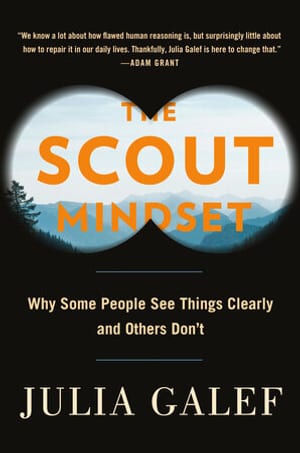
Cover image: Penguin
Read in فارسی
Trade the soldier's defence for the scout's map: ask what is true.
Chapter titles follow the English Portfolio/Penguin 2021 edition. The one quote is Galef's own definition; everything else is paraphrased.
Ask “Is it true?” instead of “Can I believe it?”
Run one of the five bias tests on a belief you care about.
Put a number on how sure you are, then check it later.
Treat being wrong as updating, not as losing.
Listen to the most reasonable people who disagree with you.
Hold your identity lightly: a description, not a flag.
Julia Galef's The Scout Mindset: Why Some People See Things Clearly and Others Don't (2021) argues that good judgment depends less on intelligence than on scout mindset, “the motivation to see things as they are, not as you wish they were,” and that anyone can build it with a few habits and honest tests.
Enter your email and confirm that we may store it with the language of this page and the name of this book. We use that to give you the deck and to know which summary you asked for.
Listen to Ketabcard’s audio summary of this book.
Galef defines scout mindset as “the motivation to see things as they are, not as you wish they were.” She opens with the Dreyfus affair: French officers convicted an innocent man on weak evidence, while Colonel Georges Picquart, who had also believed Dreyfus guilty, followed a handwriting match that pointed to someone else. The soldier asks “Can I believe it?” or “Must I believe it?” The scout asks “Is it true?” and treats being wrong as a chance to fix the map.
If seeing clearly is so useful, why do we slip into soldier mindset? Galef's answer: it protects things we care about. Three are emotional: comfort (avoiding painful feelings), self-esteem (feeling good about ourselves) and morale (finding the nerve to do hard things). Three are social: persuasion (convincing ourselves so we can convince others), image (holding beliefs that make us look good) and belonging (fitting in with our group). These needs are real; the question is whether self-deception is the best way to meet them.
We make these trade-offs without noticing, and Galef argues we get them wrong in a predictable direction. We overvalue the instant relief of soldier mindset, the way we prefer a small reward now to a bigger one later. We underestimate the value of building scout habits, overlook the ripple effects of fooling ourselves, and overestimate the social cost of honesty. Our instincts formed in a world with fewer choices; today an accurate map is worth more than ever.
Feeling objective, or being smart and well informed, does not make you a scout; on charged topics, more knowledge can even deepen the divide. What counts is behaviour you can point to. Do you tell people when they turn out to be right? How do you react to criticism? Do you ever prove yourself wrong, or decide in advance what will count as failure? Can you name thoughtful critics? And perhaps the clearest sign: can you recall moments when you were in soldier mindset?
Like a magician's forcing trick, our minds steer us to a conclusion while letting us feel free. Galef's remedy is to imagine the counterfactual and watch your reaction. Five tests: the double standard test (would I judge the other side the same way?), the outsider test (what would someone in my shoes do?), the conformity test (would I hold this view if others dropped it?), the selective skeptic test (would I trust this evidence if it favoured the other side?) and the status quo test (would I choose this if it weren't already the default?).
Scouts think in shades of grey: they can feel the difference between 95, 75 and 55 percent sure, and aim to be calibrated, so the things they call 70 percent likely happen about 70 percent of the time. Galef notes that the predictions Star Trek's Spock calls impossible come true most of the time. To find your real confidence, imagine a bet with something at stake. A claim is what the press secretary says; a bet is what the board actually decides.
After his boat sank in 1981, Steven Callahan survived 76 days adrift in the Atlantic by making clear-eyed choices about rationing and risk. Galef's point: hard moments tempt us most to fool ourselves, yet that is when an accurate map matters most. There are honest ways to cope. Make a plan for what you would do if the bad news were true; notice silver linings without pretending the whole cloud is silver; focus on a different goal; and remember that things could be worse.
Do we need to believe we will succeed in order to try? Galef says no. An honest view of the odds helps you choose between goals, adapt your plan and decide how much to stake. She notes that Elon Musk put the chances of SpaceX and Tesla at around 10 percent each, and Jeff Bezos gave Amazon about a 30 percent chance, yet both went ahead because the bets were worth taking. Scouts are driven by “this is a good bet,” not “this will work,” and accepting the odds brings calm.
Galef separates two kinds of confidence. Epistemic confidence is how sure you are about what's true; social confidence is how at ease and self-assured you seem. Research suggests people judge competence mostly by the second. So you can be honest about uncertainty and still lead: show why the uncertainty is justified, give an informed estimate, and have a plan. You can inspire people with your mission and your reasons without promising that success is guaranteed.
Superforecasters change their minds a little at a time, and when they get something wrong they ask what it teaches them instead of saying they were almost right. Galef suggests swapping “admitting a mistake” for “updating”: new information is a routine reason to adjust, not a humiliation. Chapter 11 adds: when a fact doesn't fit your view, don't explain it away. Stay curious and confused for a while. Anomalies can pile up into a bigger change of view, or reveal an option you never considered.
Simply hearing the other side often makes people more polarized, because we tend to hear its loudest and least charitable voices. Galef's advice is to choose your sources with care: listen to people you find reasonable, people who share some intellectual common ground with you, and people who share your goals. Even then, expect it to be hard. We misunderstand each other's views, weak arguments can make us deaf to strong ones, and changing one belief often means rethinking others connected to it.
Beliefs turn into identities when we feel embattled or proud of them. Warning signs include saying “I believe,” getting annoyed when a view is criticised, a righteous tone, gatekeeping and enjoying the other side's failures. Galef's advice is to hold your identity lightly, as a description rather than a flag. One check is the ideological Turing test: can you explain the other side's view so well that a believer couldn't tell? Finally, make being a truth-seeker part of who you are, and choose communities and role models that reward it.
The Scout Mindset was written by Julia Galef.
Key lessons include: Ask “Is it true?” instead of “Can I believe it?”; Run one of the five bias tests on a belief you care about.; Put a number on how sure you are, then check it later.
This summary is for readers who want trade the soldier's defence for the scout's map: ask what is true.
The same summary, as swipeable cards.
BOOK NOTES · THE SCOUT MINDSETJulia Galef's The Scout Mindset: Why Some People See Things Clearly and Others Don't (2021) argues that good judgment depends less on intelligence than on scout mindset, “the motivation to see things as they are, not as you wish they were,” and that anyone can build it with a few habits and honest tests.