1We're All in Sales Now
Predictions that the internet would make salespeople obsolete were wrong: about 1 in 9 American workers still sells for a living. But Pink argues the other 8 sell too. He calls it non-sales selling: persuading, influencing and convincing others in ways that do not involve anyone making a purchase. In a survey of workers he commissioned, people reported spending around 40 percent of their time at work moving others, and saw it as critical to their success.
2Entrepreneurship, Elasticity, and Ed-Med
Three forces pulled so many of us into selling. Entrepreneurship: technology lowered the barriers to starting something small, and a solo founder has to sell as well as make. Elasticity: in flatter, fast-changing organizations, jobs stretch across boundaries, and that stretch almost always includes moving others. Ed-Med: education and health care, which Pink calls the fastest-growing sectors, are all about persuading people to give time and effort today for a better tomorrow.
3From Caveat Emptor to Caveat Venditor
Why does selling feel distasteful? Pink traces the feeling to information asymmetry: for a long time the seller knew far more than the buyer, which made deception easy and gave rise to the rule caveat emptor, buyer beware. Today buyers can research, compare and talk back, so the balance has shifted toward information parity and caveat venditor, seller beware. In that world honesty, fairness and transparency become the practical path, and sellers become curators and clarifiers of information.
4Attunement
The old motto was Always Be Closing; Pink offers new ABCs: Attunement, Buoyancy and Clarity. Attunement is bringing your actions and outlook into harmony with other people and the context. His three rules: increase your power by reducing it, since feeling powerful narrows your view; use your head as well as your heart, because perspective-taking matters as much as empathy; and mimic strategically and subtly. He also cites research suggesting that ambiverts, not extraverts, tend to be the most effective sellers.
5Buoyancy
Anyone who tries to move others faces what a veteran salesman calls an ocean of rejection. Buoyancy is how you stay afloat, before, during and after. Before: use interrogative self-talk, asking yourself 'Can I do this?' and answering with real reasons, rather than simply pumping yourself up. During: keep a healthy balance of positive to negative emotions, and genuinely believe in what you offer. After: explain setbacks as temporary, specific and external rather than permanent, pervasive and personal.
6Clarity
When information is everywhere, solving problems people already know about matters less. What moves them is problem finding: helping them see their situation in a fresh way and uncover problems they did not know they had. That means curating information rather than just supplying it, and asking good questions. Pink describes five frames that sharpen a message: less, experience, label, blemished and potential. And clarity on how to think needs clarity on how to act, an off-ramp: a clear, simple next step.
7Pitch
With attention spans shrinking, the classic elevator pitch is wearing thin. The aim of a pitch, Pink says, is not to win instant agreement but to start a conversation that brings the other person in. He offers six successors: the one-word pitch, the question pitch, the rhyming pitch, the subject-line pitch, the Twitter pitch and the Pixar pitch, a six-sentence story structure. Before you pitch, decide what you want people to know, to feel and to do.
8Improvise
Scripts worked when conditions were stable and sellers held most of the information; today's encounters are less predictable. When a well-prepared pitch goes off course, Pink borrows three rules from improvisational theater. Hear offers: listen fully, without waiting for your turn, and treat what the other person says as something to build on. Say 'Yes, and' instead of 'Yes, but', which keeps the exchange moving. And make your partner look good, looking for outcomes where both sides gain.
9Serve
The final principle gives selling its meaning: serve, by making it personal and making it purposeful. Pink describes research in which radiologists wrote more thorough reports when a photo of the patient was attached to the scan; seeing the person changes the work. Purpose matters too, since people are moved by more than self-interest. Borrowing from servant leadership, he proposes servant selling and two tests: if they agree, will their life improve, and will the world be better when the interaction ends?

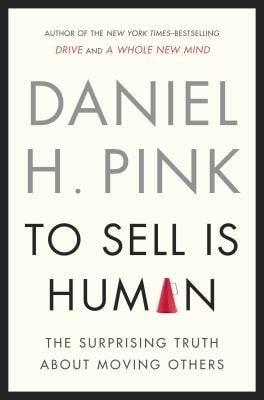
 BOOK NOTES · TO SELL IS HUMAN