1The Challenge of the Future
Doing what already works, Thiel writes, takes the world from 1 to n. Creating something new takes it from 0 to 1. He opens job interviews with a contrarian question: “What important truth do very few people agree with you on?” A good answer, he says, has the form “Most people believe in x, but the truth is the opposite of x.” His own answer is that most people think globalization will define the future, but technology matters more: spreading old ways of creating wealth, without new tools, is unsustainable.
2Party Like It's 1999
After the dot-com crash, Thiel says, four lessons hardened into dogma: make incremental advances; stay lean and unplanned; improve on existing competitors; and focus on product, not sales. He argues that the opposite principles are probably more correct: it is better to risk boldness than triviality; a bad plan is better than no plan; competitive markets destroy profits; and sales matters just as much as product. The most contrarian move, he adds, is not to oppose the crowd but to think for yourself.
3All Happy Companies Are Different
Thiel inverts Tolstoy: happy companies are different, each earning a monopoly by solving a unique problem; failed companies are the same, because they did not escape competition. Under perfect competition, he argues, profits vanish and firms cannot plan ahead. Creative monopolies invent new categories and can afford a longer view. Competition is also, for him, an ideology: rivals grow alike and lose sight of the work that matters. The aim is not to beat everyone in a crowded field, but to do something no one else is doing.
4Last Mover Advantage
Being first is a tactic, not a goal, Thiel writes. What matters is future cash flow, so it is better to be the last mover: the firm that makes the last great development in a market and enjoys years of monopoly profits. Durable monopolies, in his account, tend to rest on proprietary technology (roughly ten times better than the alternative), network effects, economies of scale, and a strong brand. His advice is to start small and monopolize a niche, then expand into adjacent markets, rather than chase a tiny slice of a huge one.
5You Are Not a Lottery Ticket
Thiel sorts views of the future into definite or indefinite, and optimistic or pessimistic. He argues that the United States has drifted from definite optimism, the mid-century habit of planning and building, toward indefinite optimism: process instead of plans, and finance or law instead of engineering. You are not a lottery ticket, in his phrasing: success is not mainly a matter of luck. If the future can be designed, the work is to plan it, not wait to see what happens.
6Follow the Money
Venture returns, Thiel argues, follow a power law: one investment can return more than the rest of a fund combined. That is why, in his view, you should only invest in a company that could, by itself, return the value of the whole fund. The same logic applies to a career or a startup: time is limited, and most value concentrates in a few outcomes. Follow the money, he says, means seeing that unequal pattern clearly, and placing a few bold bets instead of many timid ones.
7Secrets
Contrarian thinking only makes sense, Thiel writes, if the world still has secrets left: important truths that are not yet widely believed. He distinguishes secrets of nature from secrets about people, and says you find them by looking where others are not looking, including in unfashionable fields. If you assume everything important is already known, you will not search. The interview question from chapter 1 is, in this light, a way of hunting for a secret on which a unique company could be built.
8Foundations, Culture, and Sales
A startup messed up at its foundation is hard to repair, Thiel argues: choose co-founders with care, and keep ownership, day-to-day possession, and formal control from pulling apart. Culture, for him, is a team on a mission; “a startup is the largest group of people you can convince of a plan to build a different future.” And if you build it, customers may not come. Sales and distribution, he says, matter as much as the product; the work is to pick a channel that fits, from complex sales to personal sales, advertising, or viral growth.
9Machines, Seven Questions, Founders
Thiel sees computers as complements to people, not replacements: used together, they outperform either alone, as in PayPal’s fraud work. In Seeing Green, he says most cleantech firms failed seven questions every business should answer: engineering, timing, monopoly, people, distribution, durability, and secret; he points to Tesla as a rare case that could answer them. Founders, in his portrait, often combine extreme and contradictory traits. The close is a choice: stagnation or a harder push to invent the future.

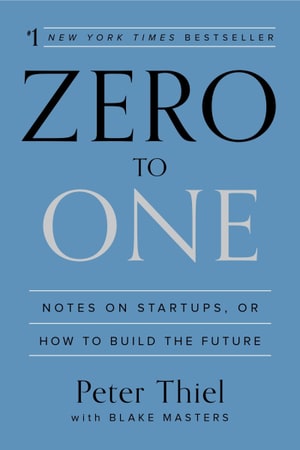
 BOOK NOTES · ZERO TO ONE