BOOK NOTES · WHEN THE BODY SAYS NO
وقتی بدن نه میگوید
01/15
BOOK SUMMARY · 19 CHAPTERS GROUPED BY THEME
When the Body Says No
The Cost of Hidden Stress
19 chapters in 11 themes + key takeaways۱۹ فصل در ۱۱ موضوع + نکتههای کلیدی

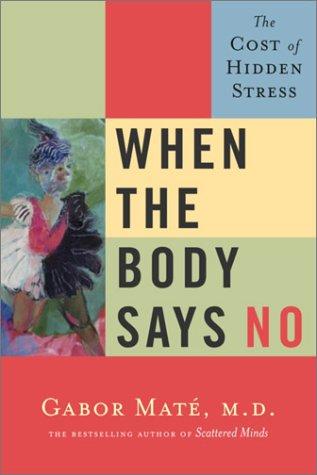
Cover image: Open Library
BOOK SUMMARY · 19 CHAPTERS GROUPED BY THEME
The Cost of Hidden Stress
Read in فارسی
What happens when we never say no? In When the Body Says No, physician Gabor Maté argues that hidden, long-term stress and repressed emotions can take a toll on the body.
This is the author's view, not medical advice. Talk to a doctor about any health concern.
Maté, a family and palliative care physician, opens with Mary, a patient with scleroderma who had learned as an abused child to care for everyone but herself. He argues that medicine splits mind from body, treating the disease but not the person. In his view, long-repressed emotions and the habit of never saying no can become a hidden stress that…
When the Body Says No was written by Gabor Maté.
Key lessons include: Maté sees mind and body as one system.; Chronic hidden stress can go unnoticed.; Learning to say no is a health skill, in his view.
This summary is for readers who want what happens when we never say no? In When the Body Says No, physician Gabor Maté argues that hidden, long-term stress and repressed emotions can take a toll on the body.
Maté, a family and palliative care physician, opens with Mary, a patient with scleroderma who had learned as an abused child to care for everyone but herself. He argues that medicine splits mind from body, treating the disease but not the person. In his view, long-repressed emotions and the habit of never saying no can become a hidden stress that the body eventually expresses. He stresses this is about understanding, not blame.
Maté, a family and palliative care physician, opens with Mary, a patient with scleroderma who had learned as an abused child to care for everyone but herself. He argues that medicine splits mind from body, treating the disease but not the person. In his view, long-repressed emotions and the habit of never saying no can become a hidden stress that the body eventually expresses. He stresses this is about understanding, not blame.
Building on Hans Selye's work, Maté describes stress as a measurable set of events in the brain, hormones and immune system, which can run without our awareness. Short bursts help us survive; he argues that chronic stress, especially when we feel no control, wears the body down. His answer is emotional competence: noticing what we feel, expressing it, setting boundaries, and telling present needs apart from old childhood ones.
Through patient stories and public figures such as cellist Jacqueline du Pré and Stephen Hawking, Maté looks at multiple sclerosis and ALS. He reports a pattern he and some researchers noticed: heavy caregiving, high competence, reluctance to ask for help, and a strong urge to be nice. He presents this as a pattern worth exploring alongside biology, not as the cause of these diseases.
Maté notes that many women with breast cancer were never asked about the stress in their lives. He argues that most cases are not inherited and that emotions and hormones influence each other. Chapter 6 follows a mother and her dying daughter, showing how unspoken feelings can pass between family members. His claims about cancer risk are his interpretation of studies, not settled science.
Maté reviews research on emotional repression and cancer, from lung and ovarian cancer to prostate cancer and melanoma, with stories including Gilda Radner and Lance Armstrong. He explains psychoneuroimmunology, the study of how the nervous, hormonal and immune systems interact. He rejects a fixed cancer personality; instead he argues that habitual repression, especially of anger, is one stress factor among many.
The gut is closely tied to our emotions. Maté looks at Crohn's disease and ulcerative colitis, then irritable bowel syndrome, whose patients often hear that it is all in their heads. He argues that the pain is real, that stress and past trauma can make the gut's nerves more sensitive, and that care should treat the whole person. The title of chapter 10 refers to a doctor's estimate of how many patients improve on placebo.
Maté explores Alzheimer's through figures such as Jonathan Swift and Ronald Reagan, suggesting that lifelong emotional shutdown may be one of many influences. In autoimmune diseases like rheumatoid arthritis and lupus, the immune system attacks the body itself. He offers a striking metaphor: when we cannot tell our own needs from others' demands, the body may echo that confusion between self and non-self.
Our stress systems are shaped early, in relationship with our caregivers. Maté describes how an attuned parent helps regulate a baby's body and emotions, and how a child can be cared for physically yet feel emotionally alone. He argues that these early experiences set lifelong patterns of coping. In his view, relationships keep regulating our physiology in adulthood too.
Maté insists parents are not to blame: they pass on the stress and coping styles they received themselves, generation after generation. He adds the social side, such as job strain and economic pressure. Drawing on biologist Bruce Lipton, he argues that genes work in an environment, and that beliefs formed early, such as having to be strong or responsible for others, can keep the stress response switched on.
Maté argues for a whole-person, biopsychosocial view of illness, recalling the old debate over whether disease depends more on the germ or on the body that hosts it. By negative thinking he does not mean pessimism, but the courage to look honestly at what is not working in our lives. He warns that compulsive optimism and an idealized memory of childhood can hide the stresses we most need to face.
Maté closes with seven principles: Acceptance of how things are; Awareness of our emotions and the body's signals; Anger, experienced and expressed in healthy ways rather than buried; Autonomy, a self with clear boundaries; Attachment, real connection with others; Assertion of who we are, without needing to earn it; and Affirmation of our creativity and our place in something larger.
The same summary, as swipeable cards.
BOOK NOTES · WHEN THE BODY SAYS NOMaté, a family and palliative care physician, opens with Mary, a patient with scleroderma who had learned as an abused child to care for everyone but herself. He argues that medicine splits mind from body, treating the disease but not the person. In his view, long-repressed emotions and the habit of never saying no can become a hidden stress that the body eventually expresses. He stresses this is about understanding, not blame.